
IISD’s Best of 2025: Publications
As 2025 draws to a close, we’re revisiting our most downloaded publications of the year.
1. State of Global Environmental Governance 2024
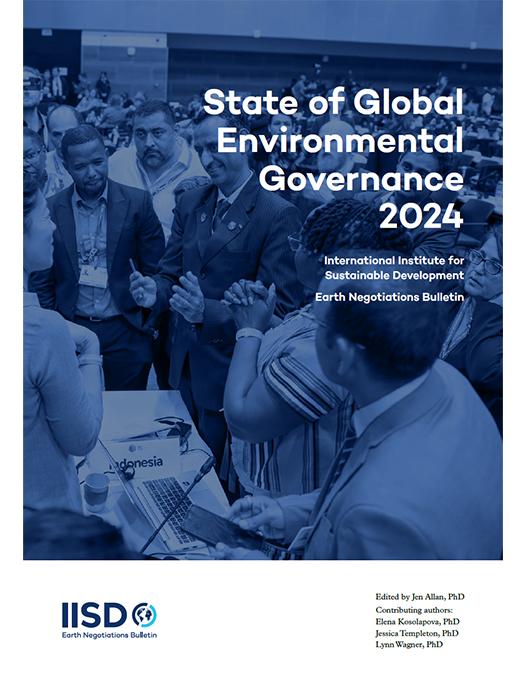
Environmental negotiations in 2024 faced major challenges against a backdrop of accelerating climate-fuelled impacts, expanding conflicts, and political turnover across many democracies. For this report, the globetrotting Earth Negotiations Bulletin team reviewed 2024’s environment and development negotiations; considered where progress was made and lost, what lessons should be applied across the multilateral ecosystem, and the evolving geopolitical context; and anticipated what to expect in 2025.
2. A Guide to the Global Agreement to End Plastic Pollution

Plastic pollution has emerged as one of the most pressing environmental crises of our time, affecting ecosystems, human health, and economies worldwide. Years of negotiations between countries to agree on a treaty to tackle the scourge of plastic pollution came to a head this year in Geneva. This report served as a guide that unpacked the history of the talks to end plastic pollution, reviewed key parts of the instrument under discussion, and identified the stakeholders shaping the talks.
3. Guidance on Border Carbon Adjustment: Results of the global stakeholder dialogues
Borden carbon adjustment (BCA) is a hot topic in global trade and climate policy, driven in part by the European Union’s Carbon Border Adjustment Mechanism coming into force and with similar regimes either pending or being explored in other countries. The report provides guidance on BCA that respects development and climate objectives, as well as developing country perspectives. It was created by a multistakeholder group of experts to balance trade, climate, and development goals.
4. Unpacking Methods for Integrated Assessments of Nature-Based Solutions: Guideline for the European Investment Bank and public authorities

Nature-based solutions (NbS) are an innovative approach to addressing societal challenges by leveraging natural processes and ecosystems—encompassing interventions that protect, restore, and sustainably manage ecosystems to deliver multiple benefits. This guideline is a comprehensive resource for developing integrated cost-benefit analyses for NbS. It provides detailed instructions at every stage of the assessment process, from identifying the benefits of NbS to exploring potential financing options and communicating findings.
5. The State of BCAs 2025
As more countries strengthen their climate policies, concerns over carbon leakage—where emissions reductions in one country are offset by increases elsewhere—have grown. To address this, several countries are implementing BCAs, with the European Union and the United Kingdom set to launch theirs by 2026 and 2027, respectively. This publication is the first of its kind taking stock of this trend.
6. Reforming Environmentally Harmful Subsidies: A playbook
Reforming environmentally harmful subsidies (EHS)—more than USD 2 trillion annually—is crucial to tackling biodiversity loss, climate change, and social inequities. This playbook offers philanthropic organizations a strategic framework to advance EHS reform, drawing on IISD expertise, research, and consultations. With over 20 actionable opportunities, it highlights EHS reform as a vital avenue for systemic transformation.
7. Why Is Investment Treaty and Investor–State Dispute Settlement Reform Needed? Questions & answers
The current investment treaty and investor–state dispute settlement system threatens climate action, human rights, and fair economic development. We need urgent reform. Find out how the system came about, how it functions, why it’s an issue, and how to reform it.
8. Innovative Financial Instruments for the Mobilization of Private Sector Investment in Climate Change Mitigation and Adaptation in Developing Countries
Mobilizing finance for climate action—including private sector investment—is essential to achieving global climate goals. This report explores eight innovative financial instruments with strong potential to attract private finance for adaptation and mitigation in developing countries and least developed countries. It outlines each instrument’s strengths, limitations, and enabling conditions, with a focus on how public finance can be used to scale their application.
9. Funding the Future: Enabling natural infrastructure through federal infrastructure programs

A flexible and nature-based approach to infrastructure funding can help Canada build resilience while making the most of every dollar invested, leading to a more sustainable and water-secure future for Canadians. This report assesses six federal infrastructure programs against 14 enabling criteria for natural infrastructure and outlines how the Canadian government can better support natural infrastructure.
10. Business Plan Template for Agricultural Cooperatives in Cambodia to Advance Sustainability
Agricultural cooperatives were created by Cambodia’s Ministry of Agriculture, Forestry, and Fisheries to help farmers shift from traditional family-based farming to stronger, more competitive enterprises. While Cambodia has 1,200 cooperatives with 170,000 members, less than a fifth are performing well due to challenges such as limited leadership, financing, competitiveness, and climate risks. This guide supports agricultural cooperatives and their partners in Cambodia to develop business plans that strengthen sustainability and resilience.
You might also be interested in
IISD Annual Report 2024–2025
IISD's reputation as a convenor, a trusted thought leader, and a go-to source on key issues within the sustainable development field is stronger than ever.
How G20 Nations can Make Progress After Group Stalls on Fossil Fuel Subsidy Reform
In this year’s Leaders’ Declaration, the G20 failed to restate their commitment to phase out fossil fuel subsidies, yet countries still have credible platforms to move forward collectively.
Over a Decade of Protecting the World's Fresh Water: Five ways IISD Experimental Lakes Area has made a difference
The Experimental Lakes Area has been transformed ever since IISD saved it from imminent closure. But, don’t just take our word for it. Here are five stories from people who have seen, firsthand, the impact of IISD-ELA over the last decade.
Electronic Commerce and the World Trade Organization
This report provides an overview of multilateral and plurilateral e-commerce processes at the World Trade Organization (WTO), highlighting recent progress and upcoming decision points ahead of the 14th Ministerial Conference (MC14), to equip policy-makers and negotiators with an up-to-date understanding of global digital trade governance.